How Do I Fly With Two Pets Internationally?
Flying internationally with one pet can feel like organizing a small diplomatic mission. Flying internationally with two pets adds another layer of planning—but it is often entirely possible with the right airline, paperwork, routing, and support.
The most important thing to understand is that international pet travel involves two separate sets of rules:
The destination country decides whether your pets may enter and which veterinary documents they need.
The airline decides whether and how your pets may travel on the aircraft.
Meeting the country’s import requirements does not guarantee that the airline will accept both pets. Likewise, having airline reservations does not guarantee that your pets meet the destination’s entry requirements.
Before buying your ticket, you need a plan that works for the airline, both pets, every country on the itinerary, and the person—or people—accompanying them.

Can One Person Fly Internationally With Two Pets?
Sometimes, but not always.
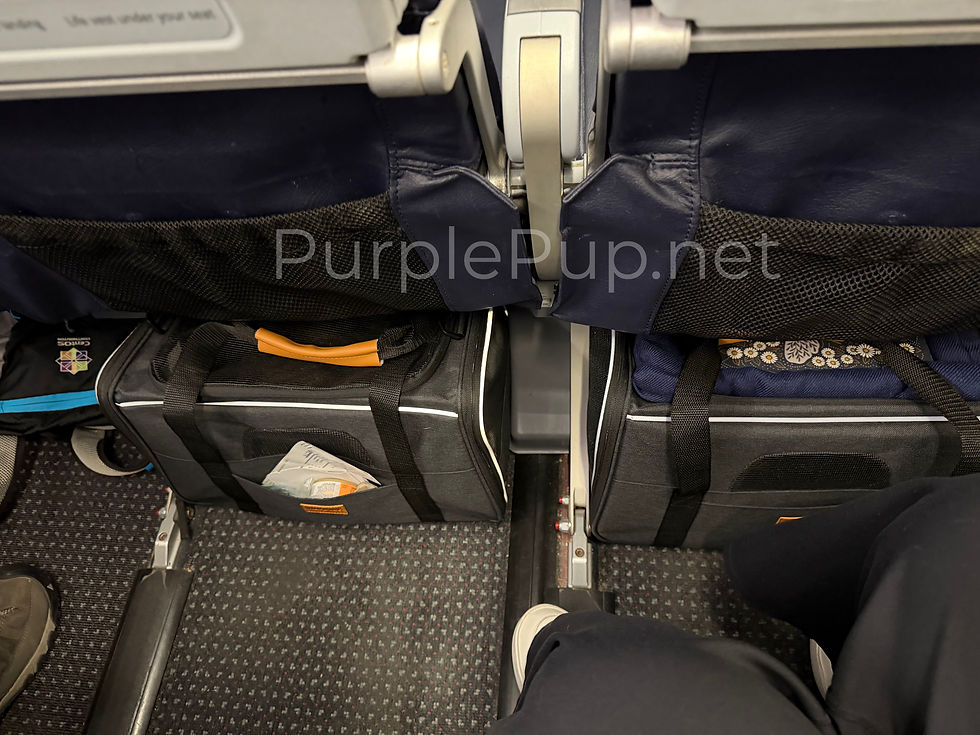
Many airlines limit each passenger to one in-cabin pet carrier. Because an in-cabin carrier usually occupies the space beneath the seat in front of the passenger, one traveler may not be allowed to reserve two separate carriers. One exception to this rule is United Airlines. On select aircraft United will allow one passenger to purchase an additional seat to carry two pets. You can explore United specific pet policies here.
PurplePup often relies on United for international pet moves from the US to several European destinations when we have more pets than people traveling!

Some airlines may allow two small, compatible pets of the same species to share one carrier. However, the animals must typically fit comfortably together and remain within the airline’s size and weight limits.
Airlines that allow two pets per carrier on international routes:
Delta allows two compatible pets per carrier but stipulates they must be under six month old to travel together. Delta pet policy.
Turkish Airlines allows two compatible pets to share an in-cabin pet carrier as longs as their combined weight does not exceed 8kg. Turkish pet policy.
Lufthansa Airlines allows two animals of the same species to share a carrier in the cabin as long as their combined weight is under 8kg. Lufthansa pet policy.
ITA Airways allows two pets to share a carrier on international flights as long as the total weight is under 8kg. ITA pet policy.
Iberia allows three small pets of the same species to share an in-cabin pet carrier if their combined weight does not exceed 8kg. Iberia pet policy.
Swiss allows two animals of the same species to share a carrier in the cabin as long as their combined weight is under 8kg. Swiss pet policy.
Austrian, Brussels and LOT have similar policies and the 8kg weight limit.
That arrangement may work for two small kittens or very young puppies. It is much less likely to work for two adult cats, two adult dogs, or pets that are not comfortable sharing a confined space.
A few airlines may allow one pet in the cabin and another as accompanied baggage in the aircraft hold. Others may require the second pet to travel as manifest cargo. The options depend on:
The airline
The international route
The aircraft
The pet’s size and breed
Seasonal temperature restrictions
The departure and arrival countries
Whether the airline accepts pets in the hold on that particular flight
Airline pet policies can change, and restrictions may differ between domestic and international flights. Always obtain confirmation directly from the airline before purchasing nonrefundable tickets.
What Is the Easiest Way to Fly With Two Pets?
For two pets small enough to travel in the cabin, the simplest arrangement is often:
Two adult travelers
One pet assigned to each traveler
One airline-approved carrier under each passenger’s seat
Both pets traveling on the same confirmed itinerary
This avoids trying to fit two pets in one carrier and allows each animal to have its own safe space.
When only one owner is traveling, another option is to hire a pet travel nanny or international flight nanny to accompany the second pet.
The owner and travel nanny may fly together, or the flight nanny may transport one of the pets on a coordinated itinerary. This can be especially helpful when the owner is also managing children, luggage, mobility limitations, a household relocation, or additional pets traveling through another method.
The pets may be tiny, but their paperwork has no respect for their size.

Step 1: Determine Whether Each Pet Can Travel in the Cabin
In-cabin pet travel is generally limited to small dogs and cats that can remain comfortably inside a carrier placed beneath the airline seat.
Before choosing an airline, consider:
Each pet’s current weight (US air carriers like United and Delta do not enforce a weight limit but need to fit comfortably in a pet carrier. European Air carriers generally have an 8kg limit)
Carrier dimensions
The pet’s height and body length. (The typical carrier size is around 18"x11"x11")
Whether the pet can stand, turn around, and reposition comfortably
The combined weight of the pet and carrier
Breed restrictions
The length of the journey
Whether two pets can safely share a carrier
Do not rely only on a carrier label that says “airline approved.” There is no single carrier size accepted by every airline. Allowable dimensions can vary by airline, aircraft, cabin, and even seat location. PurplePup recommends pet carriers that are soft and flexible with ventilation on four sides. Soft carriers without steel frames allow for compliance on most airlines and aircraft. Check out our Amazon list of pet carriers that we use on international flights.
Step 2: Research the Destination Country’s Pet Import Requirements
Each country creates its own import rules for dogs and cats.
Depending on the destination, your pets may need:
ISO-compatible microchips
Rabies vaccinations
Routine vaccinations
Veterinary health certificates
Government endorsement of the certificates
Import permits
Rabies antibody titre tests
Parasite treatments
Advance notifications
Customs appointments
Quarantine reservations
Original veterinary records
The timing and order of these steps matter.
For example, some countries require the microchip to be implanted before the rabies vaccination used for travel. Some require a waiting period after vaccination. Others require blood testing followed by an additional waiting period before entry.
When two pets are traveling, each pet normally needs their own identifying information and veterinary documentation. One pet’s certificate does not cover the other simply because they belong to the same family.
For pets departing the United States, the USDA Animal and Plant Health Inspection Service provides destination-specific guidance and explains when veterinary documents require government endorsement. Requirements should also be confirmed with the destination country’s official veterinary authority because they can change.

Step 3: Check the Rules for Returning Home
Families often focus so heavily on entering the destination that they forget to plan for the return trip.
Before leaving home, determine what both pets will need to re-enter your country.
For dogs entering the United States, CDC requirements depend partly on where the dog has been during the previous six months. The rules may include a CDC Dog Import Form, age and health conditions, microchip requirements, and additional documentation for dogs that have been in countries considered high risk for dog rabies.
Cats entering the United States are generally subject to different federal rules, although state requirements and airline policies may still apply.
Return requirements can also be affected by:
The length of the trip
The countries visited or transited
Whether vaccinations expire during travel
The pet’s country of vaccination
Whether a new health certificate is required
The state where the pet will arrive
Planning both directions at the beginning can prevent a very unpleasant surprise at the end of your trip.
Step 4: Choose the Airline Before Choosing the Flight
Finding an attractive airfare is not the same as finding a pet-friendly itinerary.
When flying internationally with two pets, contact the airline and ask:
How many in-cabin pets are allowed per passenger?
Can two pets travel in one carrier?
What are the carrier size and weight limits?
Is there a maximum number of pets allowed in the entire cabin?
Are pets accepted in your booked cabin class?
Are pets permitted on every flight segment?
Does the airline accept pets on codeshare flights?
Can one pet travel in the cabin and one as accompanied baggage?
Are there breed or seasonal restrictions?
Does the connection country allow pet transit?
Must the pets clear customs during the layover?
How is the pet reservation confirmed?
Do not assume that adding the pets to a reservation is automatic.
Airlines often limit the total number of animals permitted in the cabin. Even when passenger seats remain available, all pet spaces may already be reserved.
Whenever possible, obtain written confirmation or a reservation record showing that both pets have been accepted.
Step 5: Avoid Unnecessary Airline Changes
The cleanest international pet itinerary is usually operated by one airline—or by carriers that clearly coordinate pet acceptance.
Separate tickets and mixed-airline itineraries can create problems because one carrier may not recognize another carrier’s pet reservation. You may also need to collect baggage, enter the connecting country, clear customs, and check in again.
A route that looks less expensive online may become much more complicated when pets are involved.
Whenever possible, prioritize:
One confirmed itinerary
One airline or closely coordinated partner airlines
Generous connection times
Minimal airport changes
No overnight transit unless intentionally planned
Arrival during customs or veterinary inspection hours
Backup flights that also accept pets
A nonstop flight is usually ideal, but not if the airline does not accept your pets or the destination’s entry process cannot be completed properly.
Step 6: Investigate Transit-Country Requirements
A layover is not always “just a layover” when animals are involved.
Some countries allow pets to remain airside without formal import procedures. Others may require transit permits, veterinary documents, airline approval, or customs clearance.
The rules can change based on:
How long the layover lasts
Whether the pets stay with the passenger
Whether the pets travel in the cabin or hold
Whether baggage must be rechecked
Whether the itinerary uses separate tickets
Whether the traveler changes airports
Whether the pets enter the country’s territory
This is one reason the shortest or cheapest connection is not necessarily the safest option.
Step 7: Prepare Two Separate Travel Kits
Each pet should have an organized set of supplies and records.
Your travel kit may include:
The correct airline carrier
Absorbent pads
A thin blanket or familiar-smelling item
Collapsible water bowl
Small amount of food
Leash and secure harness
Waste bags
Cleaning wipes
Paper copies of veterinary documents
Digital copies stored on your phone
Recent photos of each pet
Airline pet reservation confirmation
Destination contact information
Any required medications
See our PurplePup recommended pet travel essentials on our Amazon Storefront.
Label each carrier clearly, but avoid attaching bulky items that prevent it from fitting properly beneath the seat.
Pets should also be acclimated to their carriers well before departure. The carrier should feel like a familiar resting space—not a surprise suitcase that appears at 4:30 on the morning of the flight.
Step 8: Plan for Airport Security
In the United States, pets traveling in the cabin are generally removed from their carriers while the empty carrier goes through screening.
With two pets, this process requires extra care.
Each pet should wear a secure harness and leash before the carrier is opened. A private screening room may be requested if there is any concern that a frightened pet could escape.
When two adults are traveling, each person can manage one pet. A solo traveler with two pets may find security much more difficult, particularly while also handling luggage, documents, shoes, electronics, and the growing suspicion that the cats have planned this entire situation together.
Can One Pet Fly in the Cabin and the Other in the Hold?
Potentially.
This may be an option when one pet is small enough for the cabin and the other is too large. However, not every airline offers accompanied-baggage or cargo service on every international route.
You will need to evaluate:
Aircraft hold capability
Temperature restrictions
Breed restrictions
Crate requirements
Check-in procedures
Cargo terminal locations
Customs clearance
Arrival handling
Whether a broker is required
Who can retrieve the pet
Pets traveling in the hold may also be handled in a different terminal from the passenger. This can complicate arrival, particularly when the owner is simultaneously clearing immigration, collecting luggage, and managing the in-cabin pet.
For some families, having a second person assist at departure or arrival makes the entire process considerably more manageable.

When Should I Hire an International Pet Travel Nanny?
Professional assistance may be useful when:
You are traveling alone with two in-cabin pets
The airline permits only one pet per passenger
You have multiple children or significant luggage
One pet needs a separate itinerary
You are unfamiliar with international pet documentation
You need door-to-door assistance
You have mobility limitations
You are moving several pets using different travel methods
The itinerary involves difficult connections or customs procedures
You want someone to coordinate the travel details on your behalf
You want to fly nonstop on a route that does not allow pets
You want to fly in business class where pets are not permitted
An international flight nanny may accompany one pet, while a pet relocation concierge may help with the broader journey—including documentation reviews, airline coordination, ground transportation, luggage logistics, and arrival planning.
These are not always the same service. Before hiring help, clarify exactly what the provider will manage and which responsibilities remain with the owner.
How Far in Advance Should I Plan?
Begin as soon as you know that international travel is likely.
For a straightforward destination, several weeks may be enough. More complicated countries may require several months because of vaccination timing, rabies titre testing, permit processing, or quarantine availability.
Early planning also provides more choices for:
Airline availability
Pet reservations
Direct routes
Veterinary appointments
Government endorsements
Appropriate carriers
Flight nanny availability
Backup travel dates
Buying your own ticket first and investigating the pet requirements afterward is one of the most common—and most expensive—international pet travel mistakes.
Final Thoughts
So, how do you fly with two pets internationally?
Start by determining whether both pets qualify for in-cabin travel. Then verify the destination country’s import requirements, the return requirements, the airline’s pet limits, and any transit-country rules.
For two small pets, the easiest solution is often two travelers with one pet assigned to each passenger. When only one owner is available, an international pet travel nanny may accompany the second pet or help coordinate a more complicated itinerary.
The best plan is not necessarily the cheapest flight or the shortest layover. It is the itinerary that works legally, logistically, and safely for both animals.
At PurplePup, we help families navigate domestic and international pet transportation with personalized planning and professional support. Whether you need a second set of hands, a flight nanny for one of your pets, or complete assistance coordinating a major international move, the goal is the same: keeping your family together while making the journey feel a little less overwhelming.
Two pets may mean twice the carriers and twice the paperwork—but they also mean twice the happy faces waiting when you finally arrive.
Start your pet travel adventure by booking a consultation here. PurplePup can walk you through your options, coach you through DIY methods, or highlight where our services can assist you with your move.


Comments